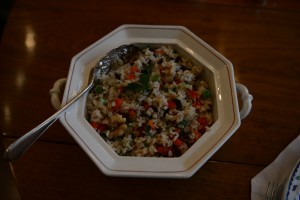
At 5 A.M. this morning, I awoke to a loud, high-pitched, piercing double beep sound. It was the sound of our electricity being restored!
Deciding that was a good time to tend to the freezers, I went down to the kitchen. The freezers were filled with chicken, vegetable and fish stocks, berries, breads, butter, milk, chocolate-covered nuts, along with a pound of scallops, all of which had already been partially defrosted. Before the condensation on all the glass containers and along the freezer floor and walls had a chance to freeze, I felt compelled to empty the freezers, wipe everything dry and put everything back into the now-electrified freezer, except for the scallops, which I planned to make for lunch along with a mixed vegetable salad with the last of my vegetable ingredients on hand. The last shopping was done 4 days ago.
Directions
- Make the vinaigrette: in a blender, mix the Dijon mustard, garlic clove, balsamic vinegar and olive oil. This is enough dressing for a few salads.
- Put 1/4 cup of the balsamic vinaigrette in the bottom of a salad bowl.
- Add the vegetables and toss.
℞ M.D. Notes
- My dear friend June adds 2 teaspoons of honey and some fresh basil leaves to her vinaigrette, which incorporates a delicious sweetness.
- I particularly like the flavors of salad dressings served at room temperature, so if storing extra dressing in the refrigerator, take it out an hour before dressing the salad.
- Cabbage is a great option in salads.
- Cabbage is an excellent source of vitamin K and a very good source of vitamin C.
- The red color in red cabbage reflects its concentration of anthocyanin polyphenols. They have health benefits as dietary antioxidants, have anti-inflammatory properties, and are potentially protective and preventive against a number of diseases. The vitamin C content in red cabbage is 6–8 times higher than that in green cabbage.
- Kale is an excellent source of vitamins A, C and K.
- Cabbage and kale (along with broccoli, cauliflower, Brussels sprouts, bok choy, collard greens and turnips) belong to the family of cruciferous vegetables. Cruciferous vegetables have a high glucosinolate content. Glucosinolates are metabolites which act as indirect antioxidants by triggering the liver to produce detoxifying enzymes which block free-radical attack on DNA.
- Tomatoes are a good source of vitamins A and C. They contain the powerful antioxidant lycopene.
- Carrots are a very good source of vitamin A.
- Carrots contain the antioxidant beta-carotene, which scientists believe may protect cell membranes from toxin damage and slow the growth of cancer cells.